I find teaching fields hard. It is by far the most abstract part of the A level course, and if I am not careful it can degenerate into ‘here are the definitions and this is how you apply the equations’. This is especially true with online learning, where discussion is more difficult and it is harder to see those moments where students make links between concepts and capitalise on them.
I also don’t have ready access to my trusty hula-hoop which I use to show how the potential varies spatially. Yes, I know it is usually used for gravitational fields, but I have always liked it when teaching about electric fields.
All this has really made me think about my own understanding, visualisation and how I see the links between values. A long time ago, as a geophysicist, I did numerical modelling of fields. As a result of this, I don’t really think in terms of equations and simple graphs, but rather I build up a map of how potential and field strength vary over an area.
I have always used the phet simulation, but this year, I thought I should introduce the topic differently. After we looked at the simulation, I showed them some hand-drawn contour plots of potential and field lines.
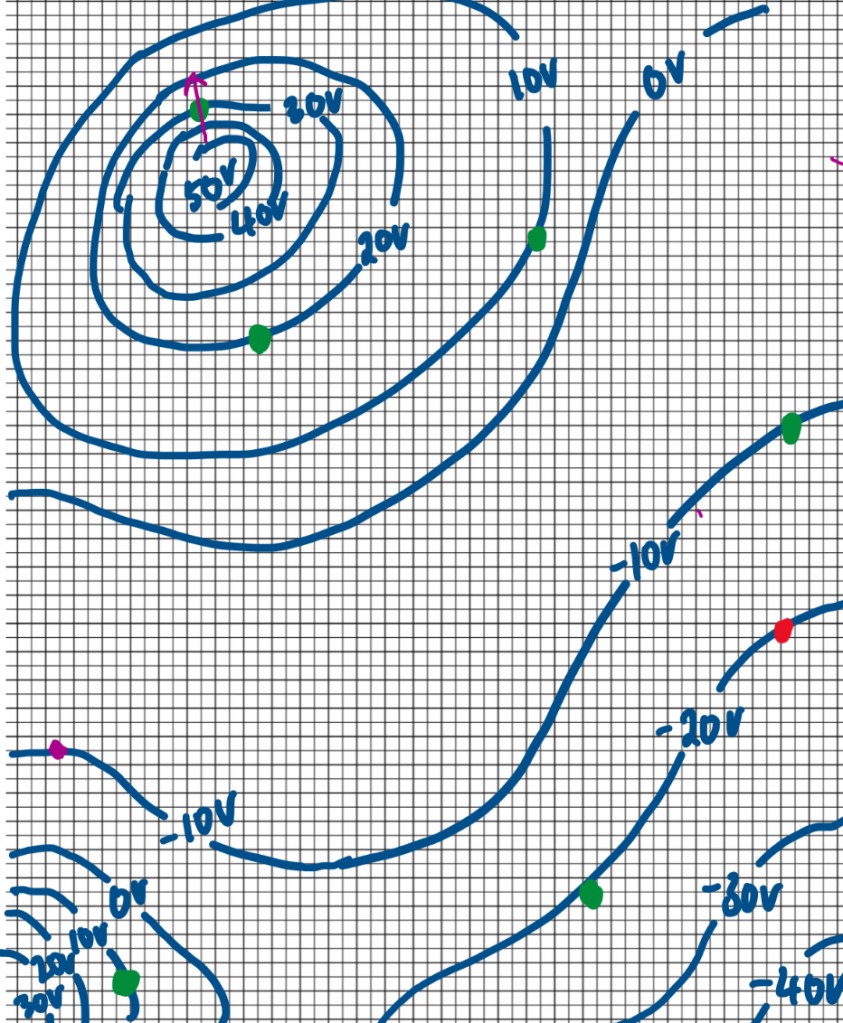
I asked the following questions:
- Draw a field line going though the point marked with an X
- Mark on any point where the electric field strength is zero.
- In which region is the field strength the highest?
- Mark any position where the field strength points vertically down the page
- Estimate the electric field strength as A if 1 cm is 10 small squares
- Draw on the direction of the electric field at all of the green dots
And it became obvious that I should have tried this long ago, so I am preparing a worksheet for next year improving this further. Because, surely, there should be a ranking questions too!
 The reflective physics teacher